How Much is a Dunk Tank? Also, are Dunk Tanks Profitable?

How Much is a Dunk Tank? Also, are Dunk Tanks Profitable?

When building or expanding an asset inventory for an event rental company, community group, or school district, choosing the right equipment requires a balance between upfront costs and long-term earnings. You need items that offer high visibility, broad appeal, simple logistics, and rapid payback periods.

While heavy investments in commercial party tents or extensive selections of folding tables and banquet chairs form the foundation of most event fleets, adding high-yield, interactive attractions is what shifts an operation from breaking even to achieving true profitability.

One of the most reliable, enduring crowd-pleasers in the entire entertainment space is the classic dunk tank.

Whether it is a school field day, a church fundraiser, a corporate team-building retreat, or a backyard birthday party, dunk tanks possess a unique magnetic pull. But for a professional B2B buyer, a purchase cannot be based purely on nostalgic appeal. You have to look closely at the underlying economics. How much does a commercial dunk tank actually cost, and are dunk tanks truly profitable additions to your inventory?

Let's break down the real costs, maintenance demands, operational safety factors, and revenue potential of commercial dunk tanks so you can make an informed, data-driven purchasing decision.

How Much is a Dunk Tank?

When looking at the market for dunk tanks, you will find a wide range of price points. It is crucial to distinguish between cheap, consumer-grade novelty items and true, commercial-grade event equipment built to withstand demanding environments.

For a reliable, B2B-ready investment, purchase prices generally fall into two primary structural categories:

1. Standard Commercial Trailer-Mounted or Foldable Dunk Tanks

  • Price Range: $3,000 to $5,500

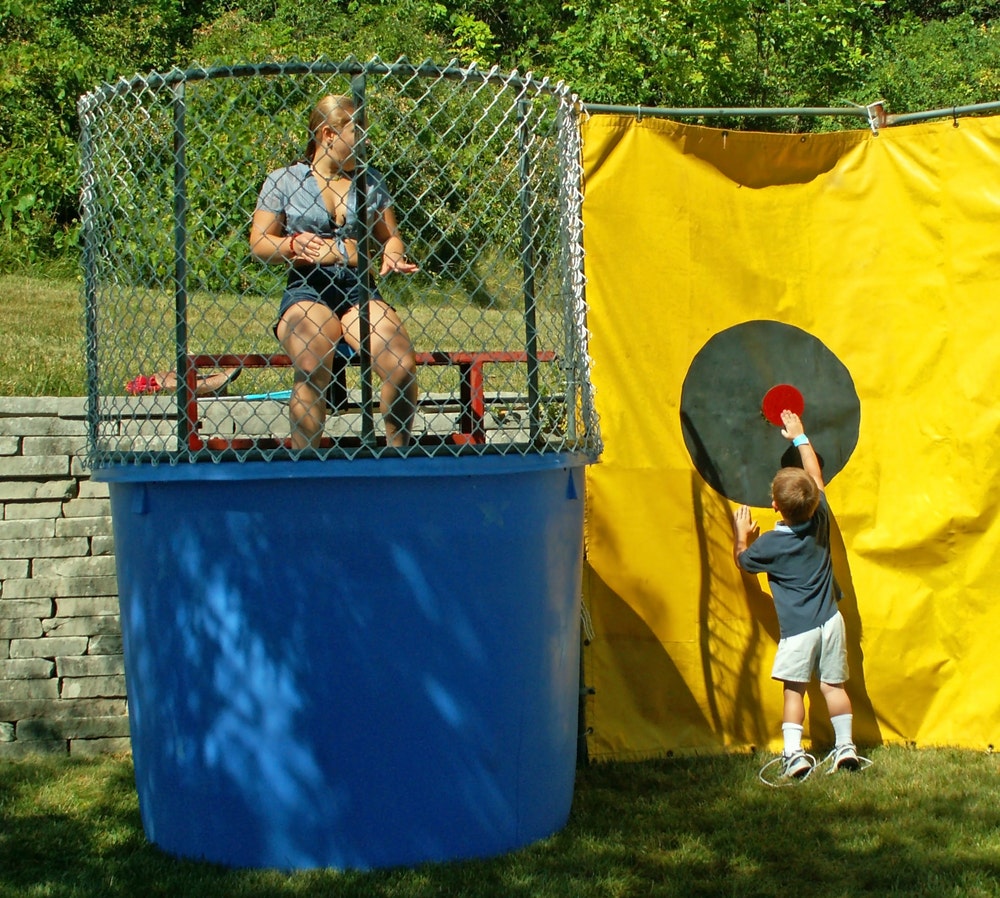
  • What You Get: These are the industry-standard models engineered for frequent transport, rapid deployment, and years of continuous heavy use. They feature heavy-duty, rotationally molded polyethylene tanks (typically ranging from 350 to 500 gallons), high-strength aluminum or steel protective cages, solid vinyl backdrops, and integrated trailer hitches or heavy-duty wheel sets for easy transport. Many premium commercial models also include built-in Lexan window panels so crowds can view the submerged participant, which heavily drives crowd engagement.

2. Compact, Space-Saving, or Inflatable Alternatives

  • Price Range: $1,200 to $2,800

  • What You Get: Designed for smaller operations, tight venues, or indoor spaces, these variations provide the same core interactive mechanism but utilize alternative footprints. This category includes high-thickness inflatable "dunk games" or modular, paneled tank systems that can be broken down to fit into a standard van or small utility trailer. While they cut down on vehicle transport requirements, they still provide excellent commercial durability when sourced from an experienced supplier.

Beware of Lower-Priced Retail Alternatives

It can be tempting to glance at residential-grade online retailers offering light-duty setups for less than $1,000. However, for schools, rental firms, and municipal agencies, these are operational liabilities. Non-commercial plastics crack under sun exposure, thin frames bend when holding hundreds of gallons of water weight, and sparse safety caging exposes your organization to immense risk.

For over 25 years, TentandTable has supplied durable, brand-new, commercial-grade equipment built for demanding environments. Investing in certified commercial structures ensures your equipment stands up to years of public use while protecting the occupants inside and out.

Are Dunk Tanks Profitable? Running the Numbers

To determine if an asset belongs in your warehouse, you need to look at its utilization rate, its average rental price point, and its total payback timeline.

Because dunk tanks are relatively simple mechanical structures with no internal motors, electrical components, or complex fabrics, their ongoing operational costs are close to zero. Once purchased, almost every dollar generated from a rental goes directly toward paying down the asset and padding your bottom line.

The Standard Revenue Breakdown

Let's look at a realistic, conservative financial model for a commercial dunk tank operating in a standard regional market:

  • Average Daily Rental Rate: $250 – $400 (Depending on location and seasonal demand)

  • Average Rentals Per Month (Peak Season): 6 to 8 rentals

  • Monthly Revenue Generation: $1,500 – $3,200

If you purchase a high-tier commercial dunk tank for $3,500, the asset can completely pay for itself within 6 to 10 rentals.

Given that a well-maintained commercial tank can easily last 8 to 10 years in a rental fleet, the long-term return on investment is exceptionally high. After the initial payback period, a single dunk tank can generate tens of thousands of dollars in pure profit over its operational lifespan.

Before adding new inventory to your fleet, it is always wise to ground your projections in real financial metrics. You can run customized scenarios using your specific regional pricing models with our dedicated online tool: try our ROI calculator to see exactly how fast a new asset will shift from a capital expense to a profit driver.

Key Factors That Drive Dunk Tank Profitability

While the basic math behind dunk tank ownership is incredibly favorable, maximizing your profitability requires strategic positioning, clever inventory cross-selling, and smart logistics management.

1. Low Maintenance Costs and Maximum Lifespan

Unlike commercial inflatables, which require continuous electrical power via dedicated blowers, meticulous drying routines to prevent mold, and specialized patching techniques, dunk tanks are structurally low-maintenance.

The maintenance cycle for a solid plastic or heavy-duty steel tank involves simple washdowns, structural bolt inspections, and occasional target trigger adjustments. This simplicity means your team spends less time in the warehouse refurbishing equipment and more time delivering orders to active job sites.

2. High Strategic Value for Cross-Selling and Bundling

In the event industry, B2B buyers rarely lease a single standalone item. If a church is planning a summer carnival or a university is hosting a spring festival, they need a complete event setup.

A dunk tank serves as an exceptional anchor product. When a client contacts you to book a dunk tank, it opens a seamless door to cross-sell comprehensive packages that expand your total ticket value. You can bundle the tank with:

  • High-volume event rentals like staging, dance floors, and specialized lighting.

  • Massive commercial party tents to provide shade for event coordinators and spectators.

  • Reliable, high-density folding tables and banquet chairs to handle seating for the broader gathering space.

By pairing an interactive game with foundational event equipment, you drastically increase your average profit margin per delivery run.

3. Expansion Into New B2B Segments

Owning unique interactive equipment gives your business access to lucrative, recurring institutional markets. Schools, corporate event planners, and local government agencies have predictable annual budgets and a constant need for safe, engaging community attractions. Securing a contract for a town’s annual Fourth of July celebration or a university’s orientation week provides highly reliable, multi-year recurring revenue streams.

Safety, Liability, and Operational Best Practices

High profitability only matters if your operations remain safe, compliant, and well-managed. Because dunk tanks involve large volumes of water and physical impacts, adhering to professional B2B safety guidelines is non-negotiable for protecting your clients and your business.

Water Weights and Logistics

A standard 500-gallon dunk tank holds roughly 4,100 pounds of water when completely full. This mass requires an incredibly stable, flat surface. Never set up a fully loaded tank on unstable terrain, steep slopes, or delicate wooden decking.

Additionally, clarify client responsibilities regarding filling and draining beforehand. The rental company typically supplies the tank and the structural gear, while the host venue provides access to a high-output water source and an authorized drainage zone.

Insurance and Risk Management

Before adding a dunk tank to your active lineup, check with your commercial insurance provider to verify your coverage limits. Ensure your rental agreements feature airtight liability waivers, clear age and physical height restrictions for participants, and mandatory requirements for continuous, adult supervision during operation.

Safety Check: The seat mechanism must feature a reliable mechanical lock that prevents accidental drops while participants are mounting or dismounting the platform.

Is a Dunk Tank Right for Your Fleet?

If you run an event rental company, coordinate logistics for a large camp or school system, or manage community outreach for a municipality, adding a commercial-grade dunk tank is a highly effective way to maximize your revenue footprint. The combination of low ongoing overhead, simple mechanical upkeep, rapid asset payback, and intense consumer demand makes it an elite earner in the commercial equipment sector.

Success in this space comes down to the quality of your foundational inventory. Partnering with an experienced, time-tested commercial supplier ensures that your equipment will perform flawlessly weekend after weekend, season after season.

Frequently Asked Questions

How long does it take to ship a commercial dunk tank to my business?

At TentandTable, we understand that timing is critical when preparing for peak event seasons. Operating out of our primary headquarters in Buffalo, NY, along with our strategic logistical networks, we offer fast nationwide shipping directly to your warehouse or commercial facility across the United States. Exact freight transit times vary by your specific geographic region, but our logistics team works to dispatch in-stock inventory rapidly so you never have to turn away a lucrative seasonal booking.

What makes a commercial-grade dunk tank different from consumer retail options?

Commercial-grade units are engineered specifically for high-frequency transport, rigorous public events, and long-term outdoor exposure. They utilize thick, UV-stabilized, rotationally molded polyethylene tanks that resist cracking, heavy galvanized steel or aluminum protective cages, and professional-grade target triggers. Consumer-grade alternatives often feature thin plastic walls, weak vinyl liners, and light aluminum framing that can warp, leak, or fail under the immense stress of holding over 4,000 pounds of water weight in public venues.

Do you offer bulk ordering or volume financing options for expanding operations?

Yes, we specialize in supporting B2B buyers looking to scale their fleets efficiently. We offer competitive tiered volume pricing for larger inventory expansions along with quick, flexible financing programs tailored to help businesses acquire high-yield assets without straining their immediate cash flow. This allows you to deploy revenue-generating equipment right away and pay down the balance as the equipment earns profit in the field.

What are the standard infrastructure requirements for setting up a dunk tank?

To safely operate a commercial dunk tank, the venue must provide a completely level, solid ground surface (such as compacted grass, asphalt, or concrete) capable of supporting over two tons of concentrated weight. The client must also provide a high-pressure water source (such as a standard outdoor spigot) and a designated drainage area capable of safely absorbing 350 to 500 gallons of water when the event concludes.

Ready to Scale Your Fleet's Revenue?

Investing in durable, high-yield commercial gear is the fastest way to outperform your local competition and secure long-term contracts. Whether you are looking to purchase a new dunk tank, expand your tent lineup, or refresh your entire supply of heavy-duty tables and chairs, our experienced team is here to guide your investment.

Contact our TentandTable team today to explore our current commercial inventory, discuss custom fleet packages, or secure fast nationwide shipping for your upcoming event season. What high-yield interactive equipment will your business deploy next to maximize your peak season profit margins?


Previous TNT’s 2021 Rental Tough Trade Show Speaker Lineup
Next Why Join Rental Organizations Like the ARA and IAAPA?
Leave a Reply