



Is a Commercial Bounce House Expensive?
 How much does a bounce house cost? Are they expensive to own? Are repairs costly? What hidden expenses are lying in wait for a bounce house owner? Do I even need a commercial grade bounce house, or will a cheaper consumer grade one better suit my needs?
If you’re reading this article, chances are you’ve been pondering most, if not all, of these questions.
To you, it’s not just a question of “how much does a bounce house cost.” You can navigate our website and find prices … that’s easy. You want to know how much a bounce house really costs. And you want to know how much it will continue to cost after you’ve made your order, too.
So here’s the TL;DR breakdown:
- Commercial bounce houses are pretty expensive, but their cost is worth it
- They’re not toys, they’re investments
- They pay for themselves reasonably quickly if you’re operating as a rental company
- You cannot and should not use consumer inflatables as bounce house rentals. People will get hurt!
Why are Commercial Bounce Houses More Expensive?
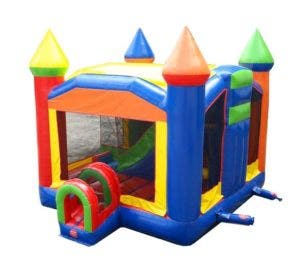 Right out of the gate, you’re going to notice a pretty sizable price gap between a consumer grade bouncy house and a commercial one. A consumer bounce house only costs around $200 to $300, or even cheaper. Meanwhile, an equally-sized commercial bounce house can cost $1000 or more. What gives?
A consumer grade bounce house is made out of cheaper materials than its commercial counterpart. Consumer inflatables are often made out of either nylon or polyester fabric (usually 400d to 600d Oxford, though some are made from 800d Oxford). The build quality is targeted more for tightly-budgeted consumer use; for instance, the seams won’t be as strong and the higher traffic areas won’t be as scrutinized. Which isn’t a problem if only a few children are using it occasionally.
All of that’s fine if you’re using your bounce house privately in your backyard maybe once or twice per month, as most families often would. But what if you intend to rent it out to paying customers? What if it’s going to be used once or twice per day, or a few times per week, often by lots of kids at once? That’s when a commercial bounce house becomes a necessity.
The commercial grade inflatables for sale at Tent and Table are made from heavy duty commercial vinyl, with reinforced high stress areas and incredibly strong seams. They feature finger-safe netting and compliance with a lengthy list of commercial regulations.
A consumer bounce house is a toy, while a commercial bounce house is an investment. You’re not buying a big commercial bounce house for private family usage (though you could). You’re buying commercial grade inflatables for larger scale usage, perhaps as a rental company, or for a public parks department, or a church, or some other organization.
How Much Does a Bounce House Cost, Then?
A commercial bounce house typically costs between $1,000 and $3,000, on average. Other commercial grade inflatables can cost even more. A bounce house slide combo, for instance, will be slightly more expensive than a standard bounce house; they’ll run anywhere from $1500 up to around $3500 for the largest bounce house slide combos.
An inflatable slip and slide costs roughly the same as a bounce house, usually in the $1000 to $3000 range. An inflatable water slide can cost upwards of $4,000. And an inflatable obstacle course can cost as much as a new car, from around $2500 to upwards of $20,000 or even more. Of course, those bigger obstacle courses run in excess of 220 feet in length, which is why they cost so much.
[product ids="2055,4777,2082,2093,2433"]
What Accessories Should be Added to the Bounce House Cost?
A deflated commercial bounce house isn’t very much fun. You’ll need to use air blowers (also known as air movers) to make it, you know, bouncy.
Every commercial grade inflatable sold by Tent and Table includes air blowers from our signature XLT series, but if you’re buying your inflatables elsewhere, make sure they include the blowers. If they don’t, you’ll need to find out what requirements they have and buy them separately.
You don’t want to just toss your heavy duty commercial grade bounce house down on grass, either. You’ll want to place a tarp on the ground first to reduce how dirty the bounce house gets (we’ve got tips on how to clean a bounce house and how to clean an inflatable water slide, too, both on a tight budget!). Having a few tarps handy can cost anywhere from $100 to $1,000, depending on how many tarps you need and what sizes of tarps you’re getting.
You’ll also want to buy some emergency inflatable repair tools and products, too. A Speedy Stitcher, some liquid cement, some vinyl repair kits and vinyl patch kits… you’re looking at another couple hundred bucks, too. But these are also necessary expenses, given your business will depend on these inflatables always being in good working order.
And then you have to consider physically moving your bounce house from one place to another. An inflatable bounce house is large, heavy, and cumbersome. They not only weigh a lot, but they’re difficult and awkward to carry. So you’re going to want to also invest in at least one hand truck or moving dolly, or several dollies and hand trucks if you’re working with multiple inflatables and have employees or family members helping other than yourself.
[product ids="3246,3099,4389,5159"]
Shipping Commercial Grade Inflatables Isn’t Easy
Another big cost you’ll want to take into consideration is the shipping. Due to the size and weight of commercial grade inflatables, we do charge an additional fee for shipping products your way. And those fees grow the further you get from our headquarters in Buffalo, New York.
The cost of shipping a standard bounce house to an address in New York State will end up in the neighborhood of $200 to $300. Meanwhile, shipping that same bounce house out to California can cost upwards of $500.
Prices increase further if you need to incorporate the use of a liftgate, and there’s a smaller fee if you’re using your own shipping company. The only way to get around these additional fees is to pick it up yourself here in Buffalo, if that’s an option of course.
See our general shipping information if you’d like to learn more.
Pricing Out a Full Bounce House Purchase, with Accessories
So let’s buy a bounce house with an attached inflatable slide, and all the required accessories we’ll need. And then let’s ship it out to San Diego, California, which is clear across the country from Buffalo. What’s our total cost going to be?
For our example, we’re going to buy a fictional bounce house with slide combo for $2,750. Its dimensions are 26 feet long, 20 feet wide, and 15 feet high, and it weighs around 400 pounds. Shipping to San Diego (zip code 92116) will cost about $450.
We’re going to get a tarp large enough to go under our inflatable, so we’re going to get a 20’ x 30’ tarp for $200. And we’re going to also buy some vinyl repair products—a vinyl repair kit for $25, some HH66 vinyl cement glue for $10, and a Speedy Stitcher Sewing Awl Kit for $30. So there’s another $65. Oh! And we better not forget a hand truck. That’s another $400.
Related: How to Patch a Bounce House Like a Pro
Grand total, our commercial bounce house costs $3,865, including shipping (please note however that these are just very rough estimates and actual costs will vary). And that might seem like a pretty steep price, especially given that the bounce house initially only cost $2,750.
A Bounce House Costs A Lot ... but You’ll Make It Back!
So here’s the good news: a commercial bounce house can be extremely profitable, and will end up paying for itself within a pretty reasonable number of uses.
Over the summer, we conducted some research into the average bounce house rental prices in the United States. We concluded that the average price to rent a bounce house in the United States is approximately $238.44. So if we were renting out our bounce house at that average price, we’d need to rent it approximately 16.2 times to see a return on our investment.
How feasible is that? It largely depends on your service area, your competitors, and a number of other factors. But in an average area, your inflatable rental unit is going to see a lot of action; you could be renting it out several times per week, and will typically see the bounce house pay for itself within a single season of uses. Most bounce houses will pay for themselves within 10 to 20 uses, depending on your investment cost, your rental costs (fuel usage, staffing, etc.), and how much you’re charging per rental.
How Much a Bounce House Costs is Ultimately Up to You
Whether you’re investing in a standard bounce house, an inflatable water slide, a bounce house with slide combo, or an inflatable obstacle course, you’re going to want to calculate the total cost as best as possible and decide if that product is right for you and your inflatable rental company.
Commercial grade inflatables are serious investments and shouldn’t be approached on a whim. Your inflatable bounce houses can provide countless hours of fun to your customers, but you’ll really want to consider this patiently and figure out which options will net you the strongest profit in your area over time.
If you want to speak with an expert in inflatables, you can call us toll free at 1-716-832-8368 and we’ll gladly help you find what’s best for your needs.
At the end of the day, the question “how much does a bounce house cost” fluctuates by necessity. It’s not a matter of how much a bounce house costs, but how much a bounce house costs to you. How big of a bounce house do you want? How much of an investment should you make into accessories? These are factors you’ll want to calculate yourself. But once you do, you can be confident your commercial inflatable purchase will pay for itself in due time.